
Gravel Road & Construction Access Road Building in the Texas Hill Country: Materials, Drainage, and What Lasts


Gravel Road & Construction Access Road Building in the Texas Hill Country: Road Base, Caliche, and What Lasts
You just bought five acres — or fifty — in the Texas Hill Country. Maybe you're in Comal County outside Spring Branch. Maybe it's a piece of land in Kendall or Blanco County. Either way, you've got a vision for what that land becomes, and none of it happens until you can get to the back of the property.
That's where gravel road and construction access road building come in.
A good access road is not just a convenience. It's the difference between a property you can actually use and a piece of land you can only look at from the top of the hill. And in the Hill Country, where the terrain fights you, and the rain comes in flash floods instead of steady showers, building a road that holds up takes more than a grader and a load of road base.
Dustin Gass at LandPrep.com has built ranch roads, gravel roads, and switchback construction access roads across Comal County (Spring Branch, Bulverde, Canyon Lake, New Braunfels), Kendall County (Boerne), Blanco County, Kerr County (Kerrville), and surrounding areas — including Bexar County and San Antonio.
Get a Free Road Estimate: CLICK HERE
Table of Contents
Road Base and Surface Materials — What Actually Holds Up
The Material Decision That Determines How Long Your Gravel Road Lasts
Caliche — The Base Layer That Often Comes from Your Own Land
Crushed Limestone Road Base — What Most People Call "Gravel"
Surface Options — Decomposed Granite and Recycled Asphalt for Dust Control
A Well-Built Gravel Road Is Ready for Whatever Surface Comes Next
Drainage — The Thing That Determines Whether Your Road Survives
Hill Country Terrain and What It Means for Gravel Road Costs
What is the best base material for a gravel road or access road in the Texas Hill Country?
How much does it cost to build a gravel road or construction access road in Texas?
Does a a gravel road or access road require a permit in Texas?
How often does a a gravel road or access road need maintenance in Texas?
What is decomposed granite and why would I use it on my road?
What is recycled asphalt and is it a good choice for a Hill Country road?
Can I upgrade my gravel road to asphalt, chip seal, or concrete later?
How long does it take to build a gravel road or construction access road in the Hill Country?
What You're Actually Building
A Gravel Road or Construction Access Road Is an Investment in Your Whole Property
Most people think of a gravel road or access road as a means to an end — a way to get equipment or vehicles from the gate to the back of the land. And it is that. But a well-built road does more than provide access.

It unlocks the portions of your property you couldn't use before. It protects everything downstream from water damage. It raises the value of the land. And if you're planning to build a home, a barndominium, or any kind of structure further down the hill, a properly built road is the first step in making that happen.
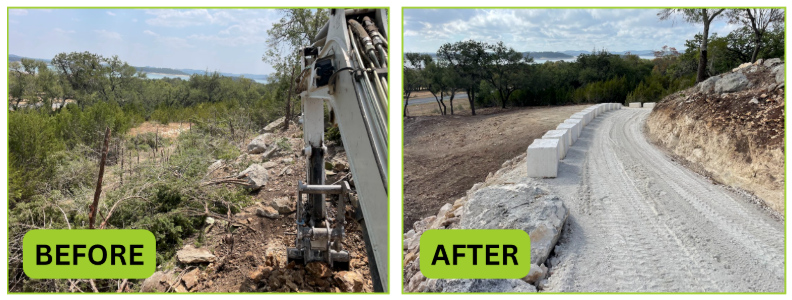
The properties that LandPrep.com works with in the Texas Hill Country — particularly those in Comal, Blanco, and Kendall counties — are often parcels where a significant portion of the land sits below a steep hill or at the back of a rocky ridge. The owner bought those acres, but without a road, they can't use them.
As Dustin of LandPrep.com explains it: a lot of the people he works with out here are building their forever home. They're going to retire on this property. They'll be here for decades. That's a long time to own land you can't get to.
Before any road base material goes down, before a single load of crushed limestone arrives, a gravel road or construction access road in the Hill Country starts with two things: clearing the right-of-way and planning drainage.
Before the Base Goes Down
Step 1 — Clearing the Right-of-Way
You can't build a road through cedar trees and brush. The first step is clearing the route — removing trees, pulling stumps, and creating a clean corridor for the road to follow.
This is where Hill Country access road building connects directly to LandPrep.com's core work in land clearing.
When LandPrep.com is planning a switchback road down a steep hillside, they’re not just thinking about the road itself. They’re thinking about what needs to be cleared on each side to give equipment room to operate, and what trees along that corridor are worth keeping.
Stumps left in the road corridor will decompose over time, creating voids and soft spots under the road surface. Full root extraction before road construction — not grinding — is the standard that LandPrep.com holds itself to, for the same reason it matters on a home build site.

Step 2 — Route Planning and Grade
One of the most important decisions in gravel road and construction access road construction happens before the equipment ever starts: laying out the route.
Building a road on a hillside in the Texas Hill Country is a different challenge than grading a flat access road.
In the Hill Country, you're almost always dealing with elevation change. A five-acre property in Comal County can drop 60 to 80 vertical feet from the hilltop where the house goes to the lower portion of the land. Getting to the bottom of that hill — and back up it — with a passenger vehicle requires careful planning.
LandPrep.com starts by laying out stakes and a grid to map the route.
As Dustin of LandPrep.com explains it, this isn't always exactly where the final road will go, but it gives the customer a clear picture of how the road will get from point A to point B.
It also surfaces the real questions early: How many switchbacks are needed? Where does the grade get steep enough to require a retaining cut? Where does a water tank or utility equipment need to be accessed?

For landowners building a barndominium or secondary structure on a hillside property, construction access road planning to the build site has to be done before construction begins.
For roads designed for SUV access — not just ranch equipment or side-by-sides — grade and width requirements become non-negotiable. A road that a four-wheeler can navigate and a road that an SUV can navigate are very different builds. Wider roads, gentler grades, and physical safety barriers at the edges of steep switchbacks all add cost and complexity.
LandPrep.com puts big limestone butter blocks or naturally excavated boulders along the edges of switchback roads, so drivers have a physical and visual barrier — especially important at night.

Road Base and Surface Materials — What Actually Holds Up
The Material Decision That Determines How Long Your Gravel Road Lasts
Once the route is laid out and the right-of-way is cleared, the base material decision is the most important choice you'll make.
There are two primary components to a Hill Country gravel road: a base layer and a surface layer.
The base is almost always caliche, crushed limestone (road base / gravel), or a combination of both. The surface — what you drive on — can be the road base gravel itself, or a top dressing of decomposed granite or recycled asphalt to reduce dust and improve ride quality. The terrain and intended use should drive every material decision.
Caliche — The Base Layer That Often Comes from Your Own Land
Caliche is a naturally occurring sedimentary material — calcium carbonate mixed with soil, rock fragments, and fines — that has been used to build up road beds across South and Central Texas for generations.
One of caliche's most practical advantages in the Hill Country is that it's often already on your property. During site prep or pond building, LandPrep.com frequently excavates caliche from the land itself and uses it to build up the road sub-base before crushed limestone road base goes on top. That material would otherwise be waste — using it for road building is both cost-effective and practical.
When properly compacted and graded, caliche binds well and hardens over time, particularly in the Hill Country's dry climate. The calcium carbonate acts as a natural cement. A well-built caliche sub-base can hold up to heavy equipment traffic — livestock trailers, feed trucks, and construction vehicles — for years when topped with road base.
Caliche works well as a sub-base when: local material is available on-site or nearby, the budget is a constraint, and you're building up grade before applying crushed limestone road base on top.
The honest limitation: caliche alone can become slick when wet and is more prone to washout on steep grades under high-intensity rainfall.
That's why LandPrep.com typically uses caliche to build up the road bed and then tops it with crushed limestone road base (gravel) — giving you the economy of local material combined with the durability and drainage performance of processed road base.

Crushed Limestone Road Base — What Most People Call "Gravel"
In the Texas Hill Country, when people talk about building a gravel road, they're almost always talking about crushed limestone road base — also called "road base," "flex base," or "state base grade." Crushed limestone, road base, and gravel all refer to the same material in this region. It's the standard surface material for access roads, construction roads, and ranch driveways across Comal, Kendall, and Blanco counties.
In the Hill Country, where limestone is literally everywhere, a well-spec'd limestone base road can compact as hard as concrete after a few wet/dry cycles. It binds, it doesn't rut, and when it's built right and crowned correctly, it sheds water effectively instead of holding it.
Road base is the right call when: the road carries regular vehicle traffic, you're building a construction access road or switchback road down a steep hillside, the road will need to perform in wet conditions, and you want to build it right the first time.
The tradeoff is cost. Road base runs higher per ton than caliche, and a longer road on a steep property adds up. But the calculus is simple: a road that washes out in the first major rain and has to be rebuilt isn't the cheaper option.
Bottom line for Hill Country gravel roads: for a switchback construction access road that needs to handle SUVs and service vehicles on a steep grade — build it with road base on a caliche sub-base. For a low-use access road on flat terrain — caliche is often plenty.

Surface Options — Decomposed Granite and Recycled Asphalt for Dust Control
LandPrep.com also offers two surface treatments that can be applied on top of a gravel road base: decomposed granite (DG) and recycled asphalt. Both options significantly reduce dust — a common complaint on caliche and crushed limestone roads — while maintaining a drivable, all-weather surface.
Decomposed granite is a fine-grained granite material that compacts firmly and produces far less dust than standard road base. It's an attractive option for roads closer to homes and structures where dust is a daily nuisance.
Recycled asphalt (also called reclaimed asphalt pavement or RAP) is ground-up asphalt from old roads and parking lots. When spread and compacted on top of a road base foundation and a new tar layer is applied, it creates a firm, low-dust surface that holds up well to traffic. It's a cost-effective upgrade from a standard gravel road.
Both of these surface options require a properly built road base underneath them to perform. They're top dressings — not a substitute for doing the base work correctly first.
A Well-Built Gravel Road Is Ready for Whatever Surface Comes Next
One of the most important things to understand about building a gravel road in the Texas Hill Country is this: a properly constructed road base is the foundation for every paved road surface that exists. Chip seal, asphalt, and concrete all require a well-built, properly compacted gravel road base underneath them. If you ever want to upgrade your access road to chip seal, asphalt, or concrete in the future, that's entirely possible — but only if the base was built right in the first place.
LandPrep.com builds gravel roads to a standard that supports future paving. That means the base is compacted correctly, crowned for drainage, and graded to the spec that a paving contractor will need. Cutting corners on the base doesn't just give you a bad gravel road now — it means you'll have to tear it out and start over before you can ever pave it. Do it right the first time, and your gravel road becomes a long-term asset rather than a recurring expense.
What Happens When You Skimp on Base
A road built without adequate base depth and proper compaction will fail in predictable ways. Rutting, washboarding, erosion channels running down the middle, and — on steep roads — washouts that take the whole surface with them.
If you do it cheap on the front end and have to come back and add more gravel, mitigate water damage, or rebuild a washed-out section, you're going to spend more in the long run. It's just spread out over time. Do it right the first time.
This is the same philosophy that drives every project at LandPrep.com — across gravel road and access road building, site prep, and land clearing alike.
Drainage — The Thing That Determines Whether Your Road Survives
Water Is the Enemy of Every Gravel Road in the Hill Country
The Hill Country does not get consistent rainfall. It gets episodic, intense rainfall — storms that drop several inches in a matter of hours — over terrain with thin topsoil, steep grades, and limestone bedrock that sheds water rather than absorbing it. This is the same region where the Guadalupe River can rise 20 feet in under two hours during a flash flood event.
That water has to go somewhere. On a poorly built gravel road, it goes straight down the road surface, taking your road base material with it. On a well-built road, it gets kicked off the road before it builds any velocity or volume.
Drainage is the most important thing. If you don't handle the water coming off that hill, and the water that's potentially coming down the road, your investment doesn't survive the first big storm.
Crown and Grade — The Foundation of Road Drainage
The crown is the slight arch built across the width of the road surface — higher in the middle, sloping toward each edge. A properly crowned gravel road sheds water off the sides before it can pond on the surface and create erosion channels. On switchback roads cut into a hillside, the crown is built so that water gets kicked to the uphill side of the road, where it can be directed away from the road corridor instead of cascading down the driving surface.
This sounds simple. It isn't always done. A road graded flat — or worse, crowned in the wrong direction — becomes a drainage channel during a storm. LandPrep.com grades crown and slope direction as part of every road build.
Preventing gravel road erosion in the Texas Hill Country comes down to three things done before a storm, not after: crown, drainage outlets, and the right base material for the grade.
Culverts and Water Crossings
Any time a gravel road or construction access road crosses a draw, a seasonal creek, or a natural drainage path, that crossing needs to be built to handle what comes through it. An undersized culvert backs up water, overtops the road, and erodes the base around the pipe. A missing culvert on a road that crosses a drainage channel isn't a road — it's a dam waiting to fail.
Culvert sizing matters. In the Texas Hill Country, where a single storm can dump several inches of rain in a few hours, a culvert that handles a typical rain event won't handle the flash flood that comes twice a decade. LandPrep.com sizes culverts for the watershed, not just average rainfall.
For roads that cross seasonal draws or named drainages, low-water crossings are sometimes the right solution: reinforced concrete structures designed to pass vehicles when the water is low and to be overtoppped and survive during high-water events.

Side Ditches and Water Management
Side ditches — shallow drainage channels cut along the uphill edge of a a gravel road or access road — are standard practice on any Hill Country road that crosses a slope.
On hillside roads, water comes from above the road, not just from rain that falls on it. Side ditches cut along the uphill edge of the road intercept hillside runoff before it hits the road surface. On long switchback roads, drainage outlets — low points where water is directed off the road and down the slope — prevent any single section from accumulating enough flow to cause serious erosion.
These aren't optional features on a Hill Country road build. They're standard practice.
Hill Country Terrain and What It Means for Gravel Road Costs
The Hill Country Is Not Flat Texas
A gravel road quote for a flat property in South Texas and a gravel road or construction access road quote for a hillside property in Comal County are not comparable numbers. The variables that drive cost in the Hill Country are specific to the terrain.
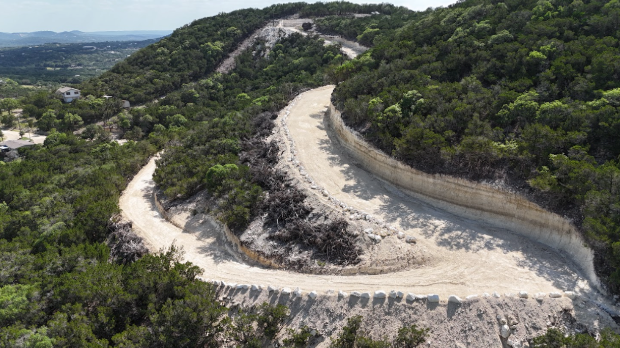
Slope and elevation change mean more earthwork. Cutting into a hillside, moving material, and building a switchback requires time, precision, and the right equipment operators. Rocky ground means the road corridor can't always be graded with a standard motor grader — sometimes surface limestone has to be broken before the route can even be established. Back-acreage access on steep properties often means the equipment and material delivery itself takes longer and costs more. And culvert installations, low-water crossings, and drainage infrastructure add cost that flat-terrain roads don't require.
None of this means a gravel road or construction access road in the Hill Country is out of reach. It means the quote has to come from a site visit — not a phone call.
LandPrep.com doesn't give road quotes over the phone for the same reason it doesn't quote cedar removal or site prep over the phone: until Dustin has walked the route and looked at the terrain, the grade, the drainage paths, and the material options, any number you get is a guess.
Basic caliche sub-base plus road base roads on accessible terrain start between $1.25-$3 per square foot, with hillside switchback builds running significantly higher.
Gravel Road and Construction Access Road Quotes for Comal, Blanco, Kendall, Gillespie, and Kerr Counties
Get a Quote That Accounts for Your Future Plans
You don't have to be a road building expert — you just need to hire one who asks the right questions before starting.
Ask any contractor:
What base material will you use, and how will you decide?
How will you handle drainage — crown, side ditches, and culverts?
What's your plan if you hit significant surface rock on the route?
Have you built roads on properties like mine in this part of the Hill Country?
If they don't have clear answers, hire someone else.
LandPrep.com serves Comal, Blanco, Kendall, Gillespie, and Kerr counties — including Fredericksburg, Kerrville, Spring Branch, Boerne, and surrounding communities — Contact Dustin to receive a FREE site visit and estimate.

Frequently Asked Questions: Gravel Road and Construction Access Road Building in the Texas Hill Country
What is the best base material for a gravel road or access road in the Texas Hill Country?
It depends on the road's use and terrain. The most common approach is a caliche sub-base topped with crushed limestone road base — caliche is often available from excavation already happening on the property (during site prep or pond building), and road base is applied on top for durability and drainage performance. For switchback roads and construction access roads on hillside properties, LandPrep.com typically recommends crushed limestone road base throughout, or a caliche base with road base on top.
How much does it cost to build a gravel road or construction access road in Texas?
Cost varies widely depending on length, terrain, grade, material choice, and whether culverts or water crossings are required. A site visit is the only way to generate an accurate estimate. Contact LandPrep.com for a free site visit and quote.
Basic caliche sub-base plus road base roads on accessible terrain start between $1.25-$3 per square foot, with hillside switchback builds running significantly higher.
Does a a gravel road or access road require a permit in Texas?
The short answer for most gravel road or access road construction on private property is that no permit is required for roads entirely on your own land, but road crossings over named waterways or work near floodplains may trigger county or TCEQ review.
How often does a a gravel road or access road need maintenance in Texas?
Caliche and road base roads typically need periodic regrading after heavy rain seasons; roads with road base on top are more durable but still benefit from annual inspection of drainage outlets and culverts. Contact LandPrep.com for maintenance and repair service in Comal, Blanco, and Kendall counties.
Adding a surface layer of decomposed granite or recycled asphalt reduces dust and can extend the time between regrading needs. Contact LandPrep.com for maintenance and repair service in Comal, Blanco, Kendall, Gillespie, and Kerr counties.
What is road base and how is it different from caliche?
In the Texas Hill Country, "road base," "crushed limestone," "flex base," and "gravel" all typically refer to the same material — processed, angular crushed limestone that compacts tightly and drains well. Caliche is a naturally occurring material excavated from the ground. It's often used to build up the road sub-base (especially when it's already available on a property from site prep or pond work). Road base goes on top of the caliche layer as the driving surface. Many locals use these terms interchangeably, but understanding the difference helps you ask better questions when getting quotes.
What is decomposed granite and why would I use it on my road?
Decomposed granite (DG) is a fine-grained granite material that compacts firmly and produces significantly less dust than standard road base or caliche. It's a popular surface treatment for the final layer of a gravel road, especially on sections close to a home where dust is a daily concern. It requires a properly built road base underneath it to perform correctly — DG is a surface material, not a base material.
What is recycled asphalt and is it a good choice for a Hill Country road?
Recycled asphalt (also called reclaimed asphalt pavement or RAP) is ground-up material from existing asphalt roads. When spread and compacted on top of an established road base, it re-bonds in the Texas heat and creates a firm, low-dust surface. It's a cost-effective alternative to decomposed granite for dust control and holds up well to regular vehicle traffic. Like DG, it works best on top of a properly built road base foundation — not as a substitute for base work.
Can I upgrade my gravel road to asphalt, chip seal, or concrete later?
Yes — and a properly built gravel road makes that possible. Chip seal, asphalt, and concrete all require a compacted, well-drained road base foundation underneath them. If your gravel road was built correctly — with proper crown, drainage, and compacted road base — a paving contractor can apply chip seal or asphalt directly on top of it without rebuilding the base. If the base was done poorly, you may have to remove it and start over before paving. This is why LandPrep.com builds gravel roads to a standard that supports future paving from day one.
Do gravel roads in the Hill Country need culverts?
If your road crosses any natural drainage path, seasonal draw, or low point that collects water during rain events — yes. Culverts (or concrete low-water crossings for larger drainage channels) are essential to keeping the road intact through heavy rainfall. The Hill Country is part of Flash Flood Alley, where storms can drop several inches of rain in a matter of hours.
What is road crowning and why does it matter?
Crowning is the practice of building a slight arch across the road surface — higher in the middle, sloping toward the edges — so water drains off the road instead of pooling on it. A properly crowned road sheds water before it builds velocity and causes erosion. A flat or incorrectly crowned road becomes a drainage channel during a storm.
How wide should a gravel access road be?
It depends on intended use. A basic access track for ATVs, side-by-sides, and light equipment may be 10 to 12 feet wide. A road designed for truck and SUV access — including service vehicles that need to reach structures, utility equipment, or a water tank — typically runs 14 to 16 feet. Switchback roads on steep terrain may need additional width at the turns to allow for turning radius.
What is a switchback road?
A switchback road is a road that descends or climbs a steep hillside by making a series of back-and-forth turns rather than going straight up or down. Switchbacks allow vehicles to navigate elevation changes that would be too steep to drive directly. In the Texas Hill Country, switchback roads are common on hillside properties where the buildable area is at the top and the remaining land — or a secondary structure — is further down the slope.
How long does it take to build a gravel road or construction access road in the Hill Country?
Timeline depends on road length, terrain complexity, material delivery schedules, and weather. A straightforward gravel access road on accessible terrain may be completed in a few days. A hillside switchback with multiple turns, drainage infrastructure, and road base will take longer. Your contractor should walk the site first and give you a realistic project timeline.
Can I build a gravel road or access road myself in Texas?
Technically possible on simple terrain, but in the Hill Country it's rarely advisable. Proper crown grading, culvert sizing, route planning on steep slopes, and base material compaction all require experience and heavy equipment. A road built without these fundamentals will fail — and fixing a failed road often costs more than building it right the first time.
Does a gravel road or access road add value to Texas land?
Yes. Access unlocks the usable acreage on a property, which directly affects appraised value and buyer appeal. A property where a buyer can get to the back of the land — and where a builder can operate equipment — is worth more than one they can't access. A well-built gravel road is one of the most functional improvements you can make to raw Texas Hill Country land.


