
How to Prep a Pad Site for a Custom Home in the Hill Country


Table of Contents
What You’re Actually Paying For
What Is Pad Site Preparation for a Custom Home?
You’ve secured a coveted tract of raw land in one of the many counties that encompass the Texas Hill Country — namely, Comal, Blanco, and Kendall counties.
It’s time to build your custom home!
This is both an exciting and overwhelming endeavor. Aligning with the best contractors is top of mind before you embark on this journey.
Dustin at LandPrep.com has a lot to say about site prep for a custom home in the Texas Hill Country, because it’s one of his specialties.
Understanding pad site preparation in the Texas Hill Country before you connect with custom home builders is paramount — skipping proper research can cost you hundreds of thousands of dollars and earn you an unstable foundation.
The widespread elevation change that makes areas like Spring Branch, Bulverde, New Braunfels, Blanco, and Boerne beautiful and unique will directly affect your foundation.

Foundation prep (pad site prep) in the Texas Hill Country involves:
Removing all trees from the build site — this includes completely removing the stumps and root systems
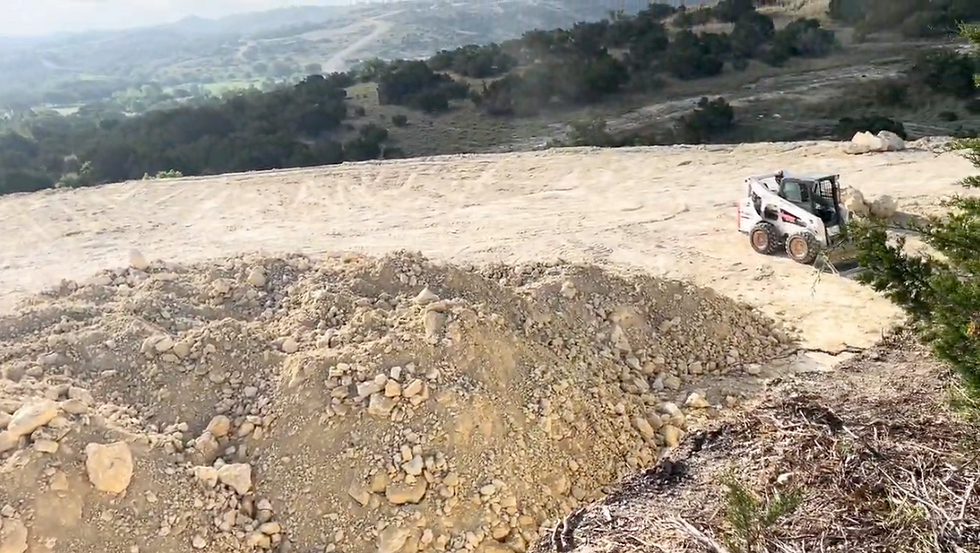
Cutting into grade — excavating limestone and other natural materials that call Comal, Blanco, and Kendall counties home
Drainage planning — while our rainfall in the Texas Hill Country may be nothing to brag about, we experience flash flooding due to our hills and thin top soil; proper drainage implementation during site prep is an investment in your future custom home
Final grade & compaction — you can’t properly grade and compact a pad site without completing all of the above steps; you would be surprised at how many contractors don’t measure up to the quality of LandPrep.com
You’re not paying to move dirt — you’re paying to create a stable, permanent foundation in one of the most difficult terrains in Texas.
What Does Pad Site Prep Cost in the Texas Hill Country?
Every property is different — a site visit is the only way to quote accurately.
LandPrep.com does pad site prep a little differently than most, and those differences results in foundation prep that puts integrity above cost savings.
Dustin of LandPrep.com warns against building your home with the natural slope of the land —
“By the time the higher elevation meets your foundation, you could be looking at 8-11 feet of foundation once everything’s built up. That along can put you at $150,000-$200,000 just in foundation cost.”
Here are some general ranges for site prep in the Texas Hill Country:
Light site prep, little to no elevation change — $8,000-$15,000
Moderate site prep, considerable elevation change — $15,000-$35,000
Heavy site prep, drastic elevation change & heavy rock — $35,000-$75,000+
Most build-ready sites land somewhere in the middle — but terrain decides everything.

Why Site Prep Costs More in the Hill Country
If you’ve gotten a few quotes for site prep in the Texas Hill Country, you’ve probably noticed something right away:
They’re higher than you expected.
And they vary — a lot.
That’s because site prep in the Hill Country is completely different from site prep on flat land. You’re not just clearing and leveling dirt. You’re working with rock, slope, and terrain that fight you every step of the way.

There are two main factors that drive the cost of pad site prep in the Texas Hill Country:
The Texas Hill Country is built on rock, not soil.
Under almost every property in this region sits limestone bedrock from the Edwards Plateau.
Out here you are breaking through solid rock rather than moving around soil.
This type of excavation mean equipment moves more slowly to prevent damage.
Slope and elevation changes add complexity.
Our hills make the Hill Country beautiful — but they require expert operators when it comes to excavation.
More slope = more work. Cutting into hillsides and moving that material takes time.
Carefully controlling grade and planning out proper drainage can be complex depending on location.
When you consider these factors during the planning phase of site prep for a custom home build in the Texas Hill Country, you start to see the full picture.
Site prep in the Texas Hill Country isn’t just more expensive, it’s more specialized. When it’s done wrong the real costs show up.
The Step-by-Step Process
Step 1 — Clearing the Build Site Properly
We won’t go into much detail in this section, because we cover land clearing and cedar removal thoroughly in another blog post:

There are a few key things to keep in mind when clearing a build site properly:
All organic material must be removed — this process is started by completely removing trees, their stumps, and root systems from the build site
Any remaining organic material after tree removal must still be removed — this includes mulch and soil
Leaving mulch on a build site creates major future problems for your foundation.

Organic material will decompose rapidly, and you will be left with open cavities underneath your foundation that will degrade the structural integrity of your home and cause settling.
Step 2 — Cut & Fill (The Most Misunderstood Step)
LandPrep.com stands behind their method of pad site prep in the Texas Hill Country.
Is it really worth it to cut into a hillside and lower your foundation when building on a hill?
The answer is a resounding “YES” because of what it saves you later.
LandPrep.com uses the “cut and fill” method when it comes to site prep for custom home builds in the Texas Hill Country.
First, material is cut away from the hillside and then moved to lower areas of the property where material is needed to achieve grade. This creates a level pad using material that is already naturally available on the build site.

The rule most contractors ignore: Always build on the cut, never on the fill.
The cut area contains undisturbed, compacted material. The filled area contains material that is less stable and more prone to shifting over time.
If you build on top of fill, your foundation can settle, causing cracking and structural issues.


Step 3 — Limestone & Rock Excavation
Breaking through the Texas Hill Country limestone during pad site prep for a custom home build is one of the biggest cost drivers during this process.

Removing rock from a build site requires the use of specialized heavy equipment, including rock saws and hammers. This equipment requires expert operators, slows jobs down, and wears quickly.
This is where a cheap bid falls apart — cut and fill site prep requires the right tools and the best operators.
Step 4 — Drainage: The Step That Protects Your Home
Planning out drainage and incorporating this into site prep is often overlooked by contractors.
LandPrep.com incorporates water flow planning, slope direction, and runoff control as a standard part of pad site prep in Comal, Blanco, and Kendall counties.
The Texas Hill Country presents several drainage challenges:
Flash flooding
Hard rock which results in poor absorption
Steep terrain
If drainage is not addressed during site prep, serious issues can arise, such as:
Water pooling under the foundation
Rapid erosion
Structural damage
Be sure to ask your contractor about their plans for drainage during site prep.

Step 5 — Final Grade & Compaction
It’s almost time for your foundation pour!
Precision grading and material compaction make up the final finishing touches of proper pad site prep in the Texas Hill Country.
LandPrep.com understands the importance of compaction. It prevents settling and ensures structural integrity.
The Build Site Problem — What Most Contractors Get Wrong
We’ve gone over common contractor mistakes in the above sections of this article, but let’s touch on them once more.
Remember: You’re about 75% through your custom home construction just by getting the site prep done correctly.
Cutting corners can be costly in the long run.
Mistake #1: Leaving Organic Material
All organic material, including mulch, should be removed from the build site.
Mistake #2: Building on Fill
Always build your home on the cut, not on the fill where material is less compacted.
Mistake #3: Ignoring Drainage
Addressing drainage during site prep for a custom home in the Texas Hill Country should come standard, but it doesn’t always. Check on this with your contractor before you hire them.
Mistake #4: Hiring Based on Price Alone
Dustin Gass of LandPrep.com was born and raised in the Texas Hill Country. Hiring a native who understands the unique needs of this land will save you money in the long run, avoiding costly foundation damage and securing your investment for generations to come.
What a Proper Pad Site Looks Like
These homeowners were unsure about how far they wanted to cut and fill. But as LandPrep.com worked and their house was built, they realized the benefits of cut and fill site prep.
By using the cut and fill site prep method, these homeowners gained a large level area all the way around the house, allowing for landscaping, more parking (even space for an RV!), and a driveway.

This method of site prep completely changed how usable their property is.

There was even enough material left over from the cut and fill process to build a beautiful driveway!

Getting a Pad Site Prep Quote in the Hill Country
Dustin Gass, owner of LandPrep.com, has a 5-generation advantage. Being a Texas Hill Country native means he has terrain-specific knowledge that is not interchangeable with flatland contractors.
You don't have to be a site prep expert — you just need to hire one who asks the right questions before starting.
Ask any contractor:
What happens to organic material left behind by land clearing?
Where will the build pad be located (on a hillside, on a cut, or on fill)?
How is drainage handled?
If they don't have clear answers, hire someone else.
LandPrep.com serves Comal, Blanco, Kendall, and surrounding counties — Contact Dustin to receive a FREE site visit and estimate.

Frequently Asked Questions: Pad Site Prep in the Hill Country
How much does pad site prep cost in Texas Hill Country?
Pad site preparation in the Texas Hill Country typically ranges from $8,000 to $75,000+, depending on your land.
Here’s a general breakdown:
Light site prep (minimal slope, little rock): $8,000–$15,000
Moderate site prep (some elevation change): $15,000–$35,000
Heavy site prep (steep terrain + limestone excavation): $35,000–$75,000+
The biggest cost drivers are:
Limestone bedrock excavation
Slope and elevation changes
Access to the build site
Every property is different. The only accurate way to price site prep for a custom home in the Hill Country Texas is with a site visit.
Can I build on fill dirt?
You can — but you shouldn’t.
Building on fill dirt is one of the most common (and costly) mistakes in foundation prep in the Hill Country.
Fill material is:
Less compacted
More prone to movement
Unstable over time
That movement leads to:
Foundation settling
Cracking
Long-term structural issues
The rule is simple: Always build on the cut, not the fill.
The cut is undisturbed, native ground.
The fill is material that has been moved — and it will move again.
Do I need to remove all trees before building?
Yes — and more importantly, you need to remove everything beneath them too.
Proper pad site preparation in the Texas Hill Country requires:
Full tree removal
Stump removal
Root system removal
Clearing of all organic material
This includes:
Mulch
Loose topsoil
Decomposing debris
Anything organic will break down over time.
If that material is left under your foundation, it creates:
Voids beneath the slab
Uneven settling
Structural instability
If it decomposes, it doesn’t belong under your house.
What is limestone excavation in site prep?
Limestone excavation is the process of cutting through solid rock to create a level building site.
In the Texas Hill Country, this is one of the biggest parts of:
👉 Hill Country building site prep
👉 foundation prep Hill Country
Unlike other regions where you’re moving soil, here you’re often:
Breaking through bedrock
Removing large limestone boulders
Using specialized equipment like rock saws and hydraulic hammers
This is why:
Jobs take longer
Equipment costs more
Skilled operators matter
Limestone excavation is also one of the biggest reasons site prep costs more in the Hill Country.
How long does site prep take?
Most pad site preparation projects in the Texas Hill Country take anywhere from:
👉 3 days to 3+ weeks
It depends on:
Size of the build site
Amount of rock (limestone excavation)
Slope and elevation changes
Weather conditions
Access to the property
A simple, flat site might be completed in a few days.
A steep, rocky Hill Country property can take weeks — especially when:
Cutting into limestone
Balancing cut and fill
Installing proper drainage
Rushing this process is where mistakes happen.
Do I need drainage planning before building?
Yes — and it should be part of your site prep, not an afterthought.
In the Texas Hill Country, drainage is critical because of:
Flash flooding
Steep slopes
Shallow soil over rock
Without proper drainage during site prep, you risk:
Water pooling under your foundation
Erosion around your home
Long-term structural damage
Proper drainage includes:
Planning slope direction
Managing runoff
Using rock and grading to move water away from the build site
Drainage starts at the cut — not after the house is built.
Can I do site prep myself?
Technically, yes.
Realistically, no — not if you want it done correctly.
Site prep for a custom home in the Hill Country Texas requires:
Heavy equipment
Experience with limestone excavation
Understanding of cut and fill
Proper grading and compaction techniques
Drainage planning
Mistakes here are not small.
They can lead to:
Foundation failure
Expensive repairs
Reduced property usability
This isn’t a DIY stage of your build.
You don’t need to be a site prep expert — you just need to hire one.
