
Building a Ranch Road After Cedar Clearing: Getting the Sequence Right


Building a Ranch Road After Cedar Clearing: Getting the Sequence Right
A lot of Texas Hill Country landowners plan a road and a cedar clearing job as two separate projects, on two separate timelines, with two separate crews. That's usually a mistake.
Building a ranch road after cedar clearing only works well when the sequence is deliberate — clear first, clear completely, then build road base on ground that's actually ready for it.
Dustin Gass has fixed enough roads built on top of rushed clearing to know exactly what goes wrong when the order gets skipped, and it's almost always the same problem showing up eighteen months later.
Table of Contents
Why Sequence Matters More Than Most Landowners Expect
Cedar clearing and road building look like two separate line items on a quote, but they're really one continuous process with a hard dependency: the road can only be as good as the ground underneath it.
Clearing First Isn't Optional
Land clearing before road building in Texas has to happen completely, not partially, along the entire road corridor — not just wide enough to fit equipment through once. Cedar left standing too close to the route ends up in the way during grading, and root systems left in the road bed itself create the exact problem road base is supposed to solve.
What Happens When Crews Skip Ahead

Some crews grade a rough path through standing cedar and lay road base right over it to save time, figuring the road will hold up in the short term. It usually does — for a while.
Dustin Gass has seen this exact shortcut fail on Comal and Kendall County ranch roads within two years of construction.
What Happens to Road Base When Organic Debris Is Buried Beneath It
This is the mechanical reason the sequence matters, not just a preference.
Decomposition Creates Voids
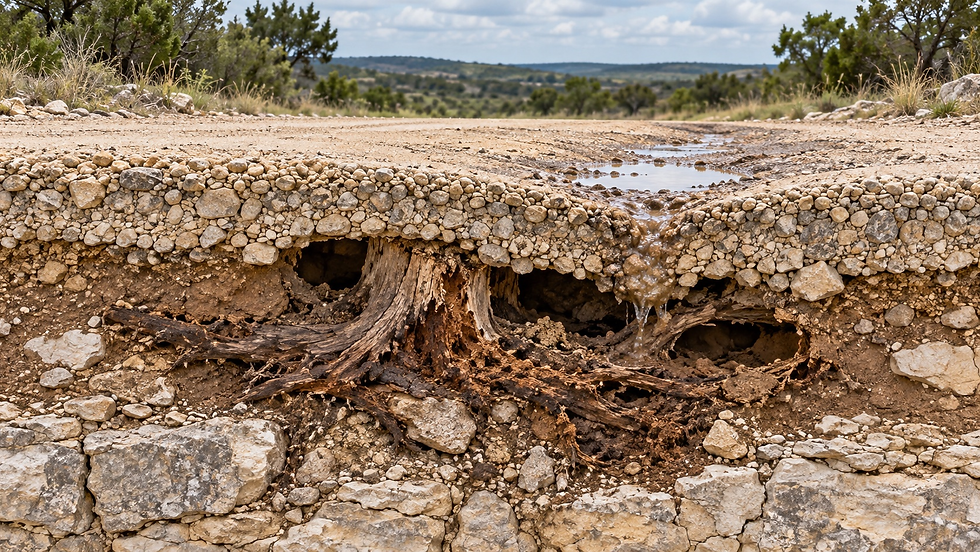
Roots, stumps, and organic debris buried under compacted road base don't stay put — they decompose over time, and decomposition leaves empty space where solid material used to be. Road base compacted on top of that eventually settles into the void, creating dips, ruts, and soft spots exactly where the debris used to sit.
Water Finds the Weak Point
Once a void or soft spot develops, water follows it. Hill Country rain events don't need much of a low spot to start eroding a road surface, and a section weakened by buried decomposition becomes the first place a ranch road washes out or potholes after a hard rain.
How LandPrep.com Manages Multi-Phase Projects
On a combined clearing-and-road project, the sequencing isn't an afterthought — it's built into how the job gets planned from day one.
One Crew, One Continuous Plan
Running clearing and road building as one coordinated project instead of two separately scheduled jobs means the road corridor gets cleared to the full width needed, organic material gets pulled and hauled off (not just pushed to the side), and grading starts on ground that's actually clean. Sequencing land prep in the Texas Hill Country this way also avoids paying for equipment mobilization twice.
Confirming Clean Ground Before Road Base Goes Down
Before any road base gets placed, the corridor gets checked for remaining roots, stumps, or organic material — not assumed clean because clearing happened weeks earlier. This step catches problems while they're still cheap to fix, instead of after several inches of compacted base are sitting on top of them.

LandPrep.com serves Comal, Kendall, Blanco, and Kerr counties — Contact Dustin to receive a FREE estimate for a combined clearing and road building project.
You don't have to manage the sequencing yourself — you just need a contractor who treats clearing and road building as one job, not two.
Ask any contractor:
Are you clearing the full road corridor, or just enough to get equipment through?
How do you confirm the ground is clean before road base goes down?
Have you seen roads fail from buried organic material, and how do you avoid that here?
If they don't have clear answers, hire someone else.
Frequently Asked Questions: Clearing and Road Building Sequence
Do I need to clear cedar before building a ranch road?
Yes, along the entire road corridor, not just a narrow equipment path. Leaving cedar or root systems in the road bed creates decomposition problems under the road base later, even if the surface looks fine at first.
Can I build the road first and clear cedar around it later?
Technically, but it's the wrong order. Clearing after the road is built means working around a finished surface with heavy equipment, risking damage to the road base you just paid for, and it doesn't solve the underlying issue if any organic material ended up under the road bed during construction.
How long after clearing can road building start?
Once a corridor is fully cleared and confirmed free of roots and organic debris, grading and road base can begin right away — there's no required waiting period. The key is confirming the ground is actually clean, not just that clearing "happened."
What does a failed ranch road from buried debris look like?
Typically dips, soft spots, or localized cracking that show up months to a couple of years after construction, often worse after heavy rain. It's frequently mistaken for a drainage problem when the real cause is decomposition happening underneath the surface.
Does this sequencing issue apply to driveways too, not just ranch roads?
Yes — any road base, whether it's a full ranch road, a construction access road, or a driveway, depends on clean ground underneath it. The same clearing-before-grading rule applies regardless of scale.


