
How Much Does Road Base Cost in the Texas Hill Country?


If you're budgeting a ranch road project in Comal, Kendall, or the surrounding Texas Hill Country counties, road base cost is the number that makes or breaks the estimate. The material alone — before a blade touches the ground, before a culvert goes in, before a single truck makes its first run — can represent half your total project budget or more.
And the generic pricing you find online won't help you here. A page written for Houston or flat East Texas doesn't account for Edwards Plateau limestone terrain, the distance to the nearest quarry, or the drainage engineering that separates a Texas Hill Country road that lasts from one that washes out on the first heavy rain.
This guide breaks down what road base actually costs in the Texas Hill Country — per ton, per square foot, and per mile — and what you need to understand before you sign any contractor bid.
Get a Free Road Building Estimate: Contact LandPrep.com for a FREE site visit and estimate on your road project. CLICK HERE
Table of Contents
Frequently Asked Questions: Road Base Cost in the Texas Hill Country
What 'Road Base' Actually Means in the Hill Country
Before talking price, you need to understand the terminology — because in this region, people use several terms interchangeably and don't always mean the same thing.
Caliche, Flex Base, and Crushed Limestone — What's the Difference?
In central and western Texas, "road base," "flex base," "caliche," and "crushed limestone" often get used as if they're the same product. They're not — and the difference matters to your road's performance and your wallet.
Caliche is a naturally occurring calcium carbonate material found in layers throughout much of Texas. Quality varies dramatically depending on where it's sourced. At its best, caliche compacts well and hardens into a solid surface. At its worst, it's a white clay that turns to mud in the rain and won't hold a load.
Crushed limestone flex base (also called "road base" or “gravel” in most Texas Hill Country supplier catalogs) is processed, graded, and consistently sized. It compacts harder, drains better, and performs more predictably under traffic. For roads that need to hold up to heavy equipment, feed trucks, or year-round use, this is the standard.
Decomposed granite (DG) is sometimes used in smaller driveways or low-traffic roads. It's more expensive than limestone, less stable under heavy loads, and generally not the right call for a working ranch road.
Dustin Gass of LandPrep.com puts it plainly: for a working ranch road in Comal or Kendall County, crushed limestone flex base is the baseline. "Road base" is a marketing term until you know exactly what grade of material you're getting.
Why Material Quality Matters More Here Than in Flat Texas
Texas Hill Country terrain puts road base under more stress. Flash floods move fast and hit hard across the Edwards Plateau — as Kerr and surrounding counties know well. A poorly specified road base that can't handle water infiltration and drainage load doesn't just wash out gradually. It fails fast.
The base material needs to lock together under compaction, drain laterally, and hold its grade when water moves across it. Low-grade caliche that's mostly clay does none of those things reliably. This is why the material specification matters before the price does.

Road Base Cost Per Ton in the Texas Hill Country
Material prices shift with fuel, quarry capacity, and haul distance — so treat these as market-range figures to calibrate your expectations, not contract numbers.
Crushed Limestone Flex Base
In the Hill Country region — Comal, Kendall, Blanco, Kerr, and Gillespie counties — crushed limestone flex base typically runs $20–$30 per ton delivered to site, depending on haul distance from the nearest quarry. Properties with direct highway access pay less. Remote properties with long ranch road hauls pay more.
A standard tandem dump truck carries 14–16 tons. That's roughly $280–$480 per load, before any grading or compaction labor.
What a Mile of Road Base Really Costs
Here's where the numbers get real. A standard 12-foot-wide ranch road built to 6 inches of compacted base requires approximately 1,400–1,700 tons of material per mile. At current Hill Country material prices, that's $28,000–$50,000 in material alone — before equipment, labor, grading, or drainage work.
Add grading, compaction, and basic drainage, and a mile of properly built road in accessible Hill Country terrain runs $35,000–$75,000 or more. Rocky terrain, significant elevation change, creek crossings, or culvert installation pushes costs higher — sometimes well above that range.
Per square foot, LandPrep.com's installed pricing for road base on accessible terrain starts around $1.25–$3.00 per square foot. Terrain drives the variance more than anything else.
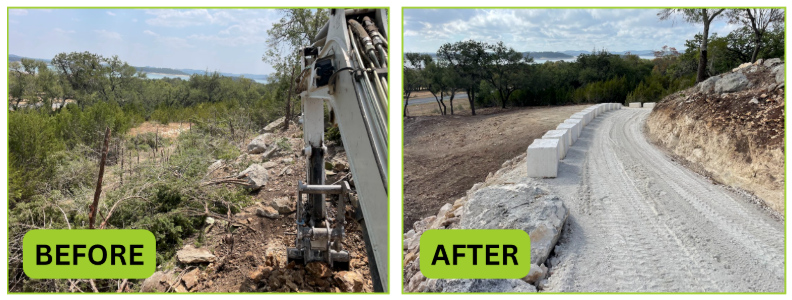
What Drives Cost Variation in Hill Country Road Projects
Haul Distance From the Quarry
In Comal and Kendall counties, you're generally within reasonable range of Central Texas limestone quarries. But remote properties — particularly those in western Kerr or Gillespie County — can add $5–$10 per ton in trucking just from haul distance. On a mile of road, that's an additional $7,000–$17,000 in material delivery costs before anything else changes.
Terrain and Drainage Requirements
The Edwards Plateau is not flat Texas. Elevation changes, rocky outcroppings, and the area's flash-flood hydrology mean road drainage isn't optional — it's structural. Every culvert, every drainage swale, every crown calculation is load-bearing work.
Culverts in this region must be sized for the full watershed above them, not average rainfall. A contractor who sizes culverts to "handle most storms" is building you a road that fails in the storms that matter most — and in the Hill Country, those storms come.

Compaction and Final Surface
Dumping road base and spreading it is not the same as building a road. Proper compaction — multiple passes with a roller or vibratory compactor — determines how the base locks and how long it holds. A road that isn't compacted correctly will rut, shift, and degrade under load. It may look finished and fail within a year.
LandPrep.com builds road base as the foundation for what comes next. Whether you chip seal, asphalt, or keep it as a gravel surface, the base has to be right the first time.
You don't have to be a road-building expert to hire the right contractor — you just need to ask the right questions before anyone breaks ground.
Ask any contractor:
What grade of crushed limestone are you specifying, and can you show me the quarry source?
How are you calculating culvert sizing — based on average rainfall or full watershed drainage?
What's your compaction standard, and how many passes will you make?
If they don't have clear answers, hire someone else.
LandPrep.com serves Comal, Blanco, Kendall, Kerr, and surrounding counties. Contact Dustin to receive a FREE site visit and road building estimate.
Frequently Asked Questions: Road Base Cost in the Texas Hill Country
How much does crushed limestone road base cost per ton in the Hill Country?
In Comal, Kendall, Blanco, and surrounding counties, expect to pay $20–$30 per ton delivered for quality crushed limestone flex base. Haul distance is the biggest variable — properties far from a Central Texas quarry pay more per load. Always ask your contractor for the material source and grade, not just a per-ton price.
How many tons of road base do I need for a mile of ranch road?
A standard 12-foot-wide road with 6 inches of compacted base requires approximately 1,400–1,700 tons per mile, depending on soil conditions and how much subgrade preparation is needed. Rocky Hill Country terrain may require additional material to fill voids or stabilize an unstable subgrade. Your contractor should calculate exact tonnage based on your specific site.
Is caliche good for ranch roads in the Texas Hill Country?
It depends on the grade. High-quality caliche — dense, rocky, and well-compacted — can perform adequately on low-traffic ranch roads. But in the Hill Country, where flash flooding and rocky terrain create extra drainage stress, most contractors recommend processed crushed limestone flex base for any road that needs to hold up to regular equipment use, heavy loads, or wet weather.
What is the total cost to build a mile of ranch road in Comal or Kendall County?
For accessible terrain — no major elevation changes or creek crossings — a properly built mile of ranch road in Comal or Kendall County typically runs $35,000–$75,000 or more, including material, grading, compaction, and basic drainage. Rocky terrain, significant grade changes, or culvert installation adds to that range. Contact LandPrep.com for a site-specific estimate.
Can I skip the road base and just grade the native soil?
In a dry summer, a graded native-soil road looks fine. The first significant rain tells the real story. Without a compacted limestone base layer, Hill Country ranch roads rut, erode, and wash out — sometimes catastrophically in a flash flood event. Native soil grading is appropriate only for very low-traffic paths where access isn't time-sensitive. For anything else, invest in proper base material the first time.
Does LandPrep.com build roads in Kerr and Gillespie counties?
Yes. LandPrep.com serves Comal, Blanco, Kendall, Kerr, Gillespie, and surrounding Hill Country counties. Contact Dustin directly for a site visit and estimate on your road project.
