
Does Forestry Mulching Kill Grass Seed? What Hill Country Landowners Need to Know


Table of Contents
Does Forestry Mulching Kill Grass Seed? What Hill Country Landowners Need to Know
Frequently Asked Questions: Forestry Mulching and Grass Seed
Does forestry mulching kill existing grass seed in the soil?
How long does it take for grass to grow back after forestry mulching in Texas?
Can I use forestry mulching to prepare land for a house in Texas?
What's the difference between forestry mulching and cedar removal in the Hill Country?
Do I need to seed after forestry mulching in the Texas Hill Country?
Is forestry mulching worth it for ranch land in the Hill Country?
Does Forestry Mulching Kill Grass Seed? What Hill Country Landowners Need to Know
Forestry mulching, made popular by the term “Cedar Eater,” has become one of the most popular land clearing methods across the Texas Hill Country — and for good reason. One machine grinds cedar, brush, and scrub into a mulch mat right on the ground. No burn piles. No hauling. No waiting on a permit to light debris on fire.

But landowners in Comal, Kendall, and Kerr counties are asking a fair question before they pull the trigger: does forestry mulching kill grass seed, or will my pasture actually recover? The answer is not as simple as yes or no — and getting it wrong can cost you a full growing season or more.
At LandPrep.com, Dustin Gass has cleared thousands of acres across the Edwards Plateau. He's seen forestry mulching used exactly right — and he's also seen it used in situations where a different method would have saved the landowner time, money, and a lot of frustration. Here's what you actually need to know before you decide.
Ready to talk through clearing options for your property?
Contact Dustin at LandPrep.com for a FREE estimate — no pressure, straight answers.
What Forestry Mulching Actually Does to the Ground
The Mulch Mat: Asset or Problem?
When a forestry mulcher runs through dense cedar and brush, it leaves behind a thick layer of shredded wood. That mulch mat is the central question for grass growth.
A thin mulch layer — roughly one to two inches — can actually help grass seed germinate.
It retains moisture, moderates ground temperature, and slowly breaks down into organic matter that improves the soil. On a dry Blanco County ranch in the middle of summer, that moisture retention can make the difference between dormant native grasses coming back on their own and a bare, eroded slope.
The problem is density. Heavy cedar stands — the kind that have been left unmanaged for twenty or thirty years, like on a Kerr County property — produce a mulch mat that can run four to six inches deep or more. That depth is enough to smother germination.

Keep in mind: Typical mulch resulting from forestry mulching ranges from 6-12 inches in length. It is not traditional garden-style mulch. This large, rough-cut mulch will not break down quickly or lend itself to native grass regrowth.
Grass seed needs contact with soil to establish roots. A thick wood chip layer sits between the seed and the ground like insulation, and without that soil contact, germination stalls. You'll see the native grass seed bank get trapped under the mulch, sometimes for a full year or longer, before enough decomposition opens up the gaps.

Ashe Juniper Won't Grow Back — But Mesquite and Yaupon Will
Here's one piece of good news specific to the Hill Country: Ashe juniper (Juniperus ashei) — the cedar that dominates most of this terrain — will not regenerate from the stump or root system once it's been mulched to ground level.
That's a real advantage over South and East Texas species.
The bad news is that mesquite, yaupon holly, and other brush species will absolutely grow back after mulching, sometimes harder than before.
If your property has a mix of cedar and mesquite, you'll need a maintenance plan in place — either shredding or targeted herbicide application — to keep the regrowth from getting out of hand.
When Forestry Mulching Works for Pasture Recovery
Right-of-Ways, Fencelines, and Ranch Road Clearing
Forestry mulching earns its reputation in situations where you don't need bare ground after the job.
Clearing a fenceline along a Comal County ranch? Perfect use. Opening up a ranch road through heavy cedar? Great application. Creating a firebreak or utility easement across a hill? The mulcher handles all of it efficiently and leaves behind ground cover that prevents erosion on your slopes.
For pasture recovery specifically, the mulching method works best when the native grass seed bank under the cedar canopy is still viable. In many cases, those dormant grasses start popping up through the mulch within the first growing season — especially if you get good spring rains.
Giving the cleared land a rest period from grazing for at least the first year dramatically improves recovery. The mulch layer actually acts as a seedbed protector, holding moisture and keeping new growth from being immediately damaged.

Seeding Over Mulch on a Tight Timeline
If you're on a tighter timeline and can't wait for natural grass recovery, you can broadcast native grass seed directly over a light mulch layer.
The key is keeping the mulch depth at two inches or less — anything thicker and the seed can't make ground contact.
A light disc or drag to thin the mulch and improve seed-to-soil contact makes a real difference.
Native species that are well-suited to the Edwards Plateau — sideoats grama, little bluestem, buffalo grass — tend to establish more reliably here than introduced species, and they'll hold up better through the Kerr and Kendall County summer heat once they're established.
Not sure which clearing method is right for your land goals?
Dustin Gass at LandPrep.com has cleared properties across Comal, Kendall, Blanco, and Kerr counties.
When Forestry Mulching Is the Wrong Call
Build Sites and Foundation Prep
This is where forestry mulching gets misapplied — and where the costs show up later rather than upfront.
If you're clearing land for a home, a barndominium, or any structure that requires a foundation, forestry mulching is not the right clearing method.
Building codes require complete stump and root removal before a foundation goes in. The mulching machine grinds material to ground level, but it leaves the root system intact underground.

Those roots decompose over time. As they break down, the soil shifts — and a shifting substrate under a slab or foundation is a serious structural problem. By the time you see the symptoms, the remediation costs dwarf what proper clearing would have cost at the start.
The organic layer left behind by mulching also creates moisture retention issues in fill areas that compound the problem.

On a hillside Comal County build site where you're already dealing with Edwards Plateau limestone and clay seam variability, adding decomposing root mass into the equation is a mistake that shows up in the foundation.
What to Use Instead for Site Prep
For any build site clearing, the right method involves pulling trees out root and all, not grinding them at grade.
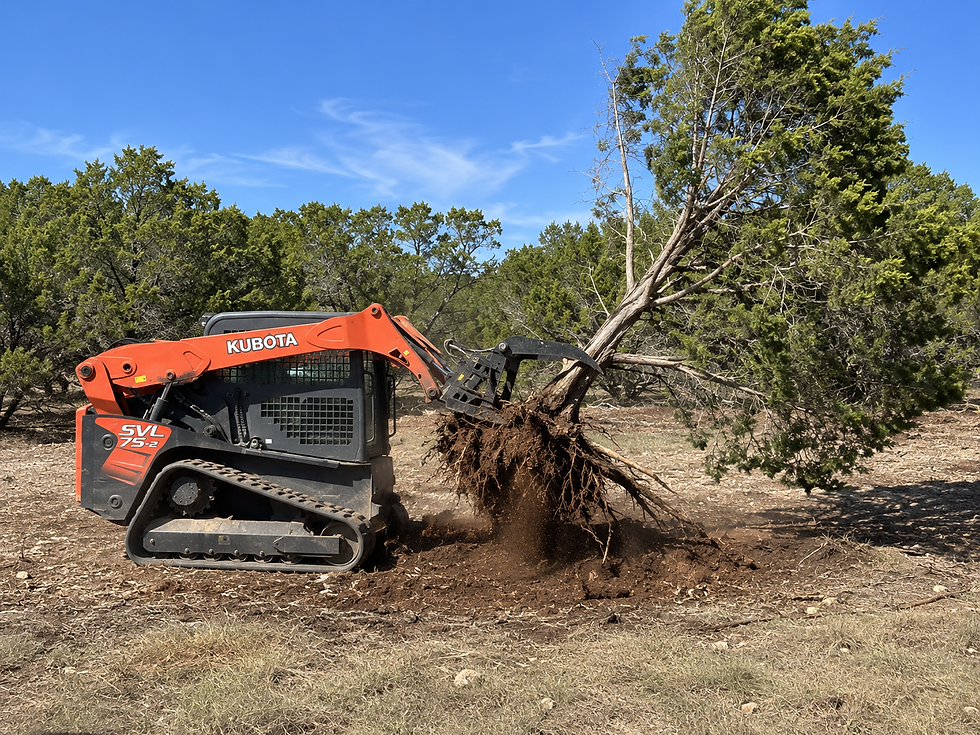
This is the core of what LandPrep.com does on clearing jobs tied to construction: cedar removal, including the stump and root system, organic material hauled or burned, soil ready for grading and foundation work.
Removing trees, stumps, and all, costs more than mulching per acre — but it's the only method that doesn't create a future foundation problem. Do it right the first time.
LandPrep.com also offers a free tree protection program for live oaks and other desirable trees on-site. Protecting the oaks while the cedars come out takes planning and care — and it's the kind of detail that separates a quality clearing job from a smash-and-grab operation.

Any pruning cuts on oaks during clearing should be sealed promptly to protect against oak wilt; the standalone oak wilt post on LandPrep.com covers the full treatment protocol.

Ask Any Contractor These Questions Before You Hire
Before you reach out to contractors for site visits and quotes, ask yourself:
Is this a pasture recovery job or a build site? (If build site, mulching is not the recommended method.)
What is the plan for species that will grow back from roots after mulching — mesquite, yaupon, and similar brush?
Before any crew runs a mulcher across your property, get clear answers on these points:
What is the mulch depth expected to be, given the density of my cedar/brush?
Do you offer a maintenance plan or follow-up shredding to keep regrowth under control?
A contractor who can't answer these questions directly isn't doing a site assessment — they're just running equipment.
The terrain across Blanco, Comal, Kendall, and Kerr counties varies enough that a clearing plan has to be built around your specific property goals, not a one-size-fits-all method recommendation.
CLICK HERE to get a FREE estimate from Dustin at LandPrep.com.
Frequently Asked Questions: Forestry Mulching and Grass Seed
What is a “Cedar Eater?”
Cedar Eater is a trademarked business name for a company that specializes in forestry mulching. The term “Cedar Eater” has been popularized by this company, and for many, the term “Cedar Eater” is used to describe the process of forestry mulching. Cedar Eaters perform the same style of forestry mulching that other contractors provide.
Does forestry mulching kill existing grass seed in the soil?
Not in most cases. The native grass seed bank under a cedar canopy is often more viable than landowners expect. Forestry mulching can actually help it recover by letting in sunlight and reducing competition. The biggest risk is a heavy mulch depth — four inches or more — which can prevent germination by blocking soil contact. Light mulch layers allow native grasses to push through within one to two growing seasons.
How long does it take for grass to grow back after forestry mulching in Texas?
In the Texas Hill Country, expect the first native grass growth to appear within three to six months after mulching if rainfall is adequate. Full pasture-level recovery typically takes twelve to eighteen months. Resting the cleared area from grazing during the first couple of years significantly speeds up the recovery timeline. Broadcasting native seed over a light mulch layer can accelerate establishment if you're working with a depleted seed bank.
Can I use forestry mulching to prepare land for a house in Texas?
No — not as a standalone method. Building codes require complete stump and root removal before any foundation work. Forestry mulching grinds material to ground level but leaves the root system in place. As those roots decompose underground, they create soil settlement that can compromise a slab or foundation. For any build site in Comal, Kendall, or Blanco counties, root-pull clearing is the correct preparation method.
What's the difference between forestry mulching and cedar removal in the Hill Country?
Forestry mulching grinds cedar and brush in place, leaving a mulch mat on the ground with stumps and root systems intact. Cedar removal — the method LandPrep.com specializes in — pulls the tree out, including the root system, then either chips, burns, or hauls the debris. Mulching is faster and works well for pasture management, right-of-ways, and brush control. Root-pull removal is required for build sites and for landowners who want a fully clean slate with no decomposing organic material underground.
Do I need to seed after forestry mulching in the Texas Hill Country?
It depends on the native grass density that existed before the cedar moved in. If the underlying soil still has a viable native seed bank — common on properties where cedar encroachment is relatively recent — natural recovery without seeding is realistic. Properties with decades of heavy cedar cover may have a depleted seed bank and will benefit from broadcasting a native grass mix appropriate for the Edwards Plateau after clearing. A land professional familiar with Kerr or Comal County soils can assess this during a site visit.
Is forestry mulching worth it for ranch land in the Hill Country?
For pasture improvement, firebreak creation, fenceline clearing, and right-of-way maintenance, yes. Forestry mulching is efficient, leaves behind soil-stabilizing organic matter, and eliminates the need for burn permits or debris hauling. For properties heading toward construction, it is not the right primary clearing method. The value calculation depends entirely on what you're planning to do with the land next — which is why the conversation with your contractor should start with your end goal, not with which machine they're running that week.
